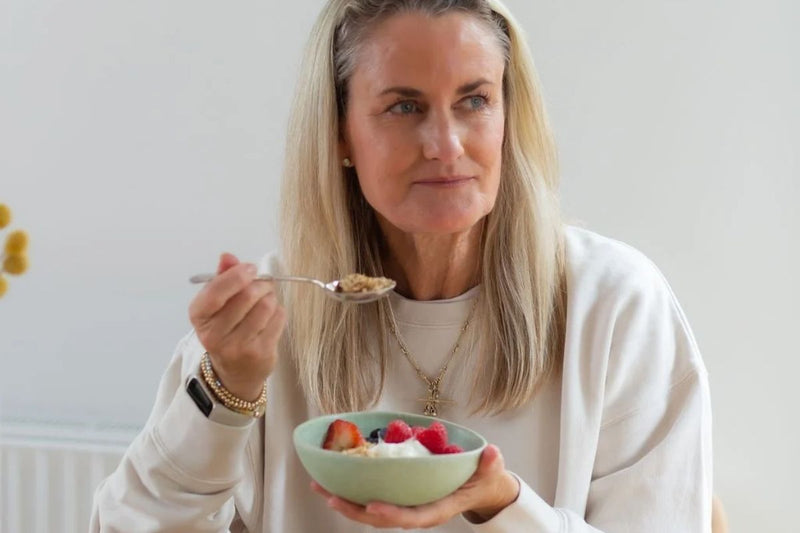
I started paying real attention to added sugar in my 40s, but it wasn't until my mid-50s that it stopped being an abstract health tip and started feeling personal. I still have a sweet tooth. I like the taste of sweeter foods, and I'm not going to pretend otherwise. But I've watched what added sugar can do to a body over decades, not just a single bad week, and that's a big part of why I built Brekky Mix the way I did.
My paternal grandmother was thin and active most of her life. She loved chocolate, Cadbury Dairy Milk specifically, and she'd turn up to family dinners with a big block of it that we'd all share afterward. One of my clearest memories of her is making coconut ice together, that pink and white two-layer coconut slice that's basically pure sugar. I didn't understand what refined sugar was actually doing back then, and honestly, I don't think she did either. She was diagnosed with diabetes in her 70s, and it changed how she had to eat for the rest of her life. For a woman who loved sweet things as much as she did, that was a real loss, not just a dietary adjustment.
I think about that a lot now that I'm in my mid-50s. Sugar's effects don't always show up right away. They show up decades later, in the form of exactly the kind of chronic conditions my grandmother lived with. So this isn't a lecture about cutting sugar out entirely. It's an explanation of the difference between the sugar your body handles well and the sugar that adds up quietly over a lifetime, because that distinction is the whole reason Brekky Mix exists.
Total sugar vs. added sugar: what each number actually tells you
Total sugars combine every gram of sugar in a product, natural and added, into one number. Added sugars are broken out underneath as their own line. That distinction matters because your body doesn't need any added sugar to function, but natural sugar in whole foods comes packaged with fiber, protein, or nutrients that change how your body processes it.
A cup of plain yogurt might show 12g of sugar on the label. All of it is lactose, a natural milk sugar, so added sugar reads 0g. A flavored yogurt with the same 12g total sugar might carry 10g of that as added sugar from syrup or cane sugar. Same total sugar number, very different nutritional story.
How to spot added sugar on an ingredient list
The ingredient list tells you where the sugar in a product actually comes from. If a sweetener appears anywhere near the top, added sugar is likely doing a lot of work in that product, regardless of what the front of the package claims.
Common names for added sugar
Added sugar shows up under a lot of different names, which is part of why it's easy to miss on a label. Look for:
- Cane sugar, beet sugar, or table sugar (sucrose)
- Corn syrup and high fructose corn syrup
- Honey and agave nectar, when added as a sweetener rather than sold on their own
- Brown rice syrup, malt syrup, and molasses
- Coconut sugar, made from boiled-down palm sap and typically treated as added sugar despite the "natural" framing
- Fruit juice concentrate, when it's added purely to sweeten rather than as the fruit itself
- Any word ending in "-ose," including dextrose, maltose, and fructose listed as a standalone ingredient
Whole ground fruit used as a sweetener, like date sugar or date paste, is a different case. It's not a syrup or a concentrate, so it's generally counted as total sugar rather than added sugar, the same way the organic upcycled dates in Brekky Mix Choc Chip are on our own nutrition panel.
The easiest way to tell fruit sugar from added sugar
You don't need to memorize chemistry to sort this out. If the ingredient list names an actual fruit, like dates, blueberries, or strawberries, that sugar is natural fruit sugar. If it names a syrup, a refined sweetener, or an isolated sugar like the ones above, that's added sugar. Whole fruit in an ingredient list reads as a fruit. Added sugar reads as a sweetener.
How fruit sugar and added sugar actually feel different in your body
This is where the label reading turns into something you can actually feel, not just read. Whole fruit carries its sugar bound up with fiber. That fiber slows how fast the sugar reaches your bloodstream, which means a gentler rise in blood sugar instead of a sharp spike. As that fiber breaks down further along your digestive tract, it also triggers hormones that signal fullness to your brain, so fruit tends to leave you satisfied rather than just sweetened.
Added sugar with no fiber attached skips that process almost entirely. It's absorbed fast, which gives you a quick lift and then, just as quickly, a drop as your body works to bring blood sugar back down. That drop is the mid-morning crash a lot of people blame on being tired or not sleeping well, when it's really just the tail end of a sugar spike from breakfast. Same starting ingredient, sugar, but a completely different experience by 10am depending on whether it arrived with fiber or without it. We break down that whole cycle, and how to avoid it, in our low sugar granola guide.
How Brekky Mix keeps added sugar low, and where the rest of the sugar comes from
Every Brekky Mix variety uses organic maple syrup as its only added sweetener. No cane sugar, no corn syrup, no artificial sweeteners like allulose or monk fruit. Added sugar is only one piece of what makes a granola genuinely healthy though, see our full healthiest granola analysis for the complete standard. Here's exactly how the total sugar in each variety breaks down between added and natural:
Brekky Mix Original
- 3g added sugar per 1/2 cup serving, all from organic maple syrup
- 0g natural sugar. Original contains no fruit, so every gram of sugar on the label is the added sugar figure
- That's 6% of the FDA's daily added sugar guideline in one serving
Brekky Mix With Fruit
- 3g added sugar per 1/2 cup serving, the same as Original
- 4g natural sugar from organic dates, organic dried blueberries, and freeze-dried strawberries, none of which have added sugar or preservatives
- 7g total sugar on the label, but only 3g of it is added sugar. The rest comes from real fruit
Brekky Mix Choc Chip
- 2g added sugar per 1/3 cup serving
- 2g natural sugar from the organic upcycled dates inside the fair-trade chocolate chips
- 4g total sugar on the label, half of it added and half of it natural, with no refined sugar anywhere in the chocolate
Total sugar and added sugar tell different stories, and With Fruit is the clearest example: 7g total sugar looks high next to Original's 3g, until you see that all 4g of the difference is natural fruit sugar, not added sugar.

Is fruit sugar bad for you?
Fructose is fruit's natural sugar. It's still sugar, but it isn't added sugar, and the difference matters. Whole fruit delivers that sugar wrapped in fiber, which slows digestion and softens the blood sugar rise a comparable amount of added sugar would cause. Research on whole fruit consistently finds no evidence it causes the problems associated with added sugar, even for people watching their blood sugar closely.
This is exactly why With Fruit and Choc Chip carry natural sugar on their labels. With Fruit gets 4g of its 7g total sugar from organic dates, organic dried blueberries, and freeze-dried strawberries, whole fruit with nothing added to any of them. Choc Chip gets 2g of its 4g total sugar from the organic upcycled dates inside its chocolate chips, the same whole-fruit approach used in the chocolate itself. Neither counts as added sugar because neither was added to sweeten the mix. It's whole fruit doing what whole fruit does.
One thing worth knowing: dried fruit is more sugar-dense than fresh fruit by weight, since removing the water concentrates everything, sugar included. That's a reason to pay attention to portion, not a reason to treat it like added sugar.
What this means for your overall nutrition
Low added sugar only matters if the rest of the plate holds up its end. Original and With Fruit each deliver 8g protein and 6g fiber per 1/2 cup serving. Choc Chip delivers 6g protein and 5g fiber per 1/3 cup serving. Protein and fiber slow digestion and extend how long you stay full, which is the same mechanism that makes natural sugar in whole food behave differently from added sugar in processed food. Brekky Mix is built around that principle on both sides of the sugar label, not just the added sugar number. For the full protein and fiber math behind why that combination keeps you full, see our high protein, high fiber breakfast guide.
I still make coconut ice sometimes, if I'm honest, just not the way my grandmother and I used to make it. I'm not interested in telling anyone to give up sweet things entirely. I like them too much for that, and I don't think that's the point. The point is understanding which sugar you're actually eating and what it's doing while you eat it, so the choice is an informed one rather than a guess. That's what I wanted breakfast to be when I started this. It's also, honestly, why I'm already thinking about what I'll bake with my grandchildren one day. I want to pass down the part of my grandmother that was making something sweet with the people you love. I just want to find a way to do it that doesn't cost what it cost her.
Want to taste the difference for yourself? The Variety Pack gets you all three varieties to compare side by side.
Frequently asked questions
What's the difference between total sugar and added sugar on a label?
Total sugar includes every gram of sugar in a food, both natural and added. Added sugar is the sugar put in during processing, like syrup or cane sugar. Only added sugar is capped by FDA daily guidelines.
How can I tell if a product has added sugar just from the ingredient list?
Look for cane sugar, corn syrup, honey, agave, or any ingredient ending in "ose," like sucrose or dextrose. These almost always signal added sugar rather than sugar naturally occurring in the food itself.
For a full breakdown of what to look for in a genuinely healthy granola, including sodium and protein benchmarks, see our granola FAQ.