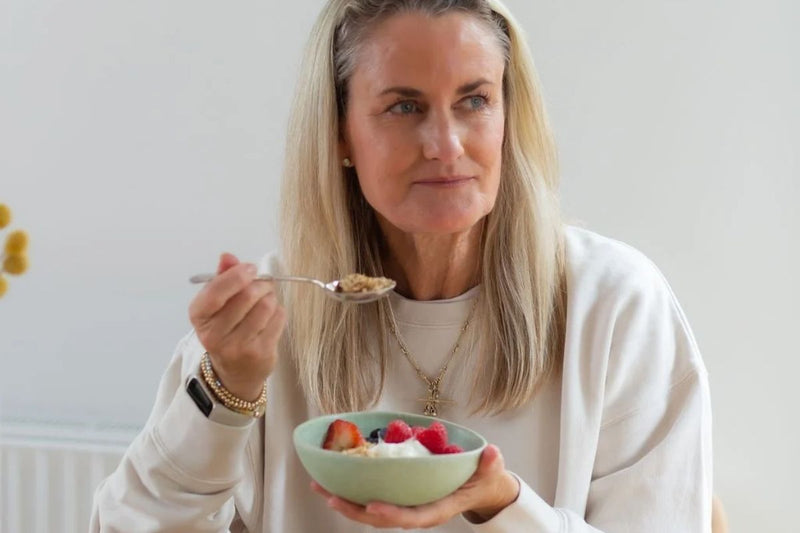
My husband has a gluten sensitivity. It showed up years before Merricks Kitchen existed, back when we were still figuring out what he could eat without feeling wrecked the next day. Oats became the anchor of our mornings early on, and they had to do two jobs at once. Gluten-free, because his system could not handle even trace cross-contamination. Organic, because the last thing a sensitive system needs is glyphosate residue sitting on top of everything else it is already working through.
This was not a wellness trend for us. It was breakfast, plain and practical, years before clean eating became something people typed into a search bar. More people are actively looking for whole food ingredients now than when we started this habit, and I am glad the wider conversation has caught up. But our reasons never had anything to do with a moment or a movement. They had to do with my husband's stomach on an ordinary Tuesday morning.
I want to walk you through exactly why we still make this choice, what the science genuinely says and does not say, and why certified organic, gluten-free oats sit at the center of every bag of Brekky Mix.
Why We Choose Organic Oats
Conventional oat farmers sometimes spray glyphosate on the crop shortly before harvest. The chemical dries the plant down evenly, which makes it faster to combine. This pre-harvest use, called desiccation, is the main reason glyphosate residue shows up in oat products at all, since the spray lands directly on the grain right before it is cut.
The European Union renewed its approval of glyphosate in November 2023, extending it through December 15, 2033, following a review by EFSA and the European Chemicals Agency. As part of that renewal, the EU specifically prohibited pre-harvest desiccation use of glyphosate across every member state, the exact use most relevant to oats.
Individual countries still layer their own rules on top of the EU-wide approval. According to a 2026 review from the European Food Information Council, no EU country has banned glyphosate outright, though several, including Austria, France, the Netherlands, Belgium, Luxembourg, and Germany, restrict its use in specific settings. Luxembourg is worth naming directly, because it is a case that gets misreported often. Luxembourg banned glyphosate outright in 2020, becoming the first EU country to do so, but its own appeals court overturned that ban in March 2023 on procedural grounds. Glyphosate products are legally back on the market there today.
The health question underneath all of this is not settled, and I want to be straightforward with you rather than pick whichever answer makes our label sound better. In 2015, the International Agency for Research on Cancer, part of the World Health Organization, classified glyphosate as a probable human carcinogen, based largely on animal studies and limited human data. The U.S. Environmental Protection Agency reached a different conclusion. Its current position states that glyphosate is not likely to be carcinogenic to humans, based on a dataset the agency describes as broader than the one IARC reviewed, and EPA states directly that it disagrees with IARC's classification. Two credible bodies, two different readings of the same underlying research. That is not a marketing talking point. That is genuinely where the science sits right now.
We do not tell you organic oats are proven safer. We tell you we chose them anyway, a precaution I chose for my own family and my own brand, not settled science. When an answer is genuinely unresolved and the stakes involve someone I love eating breakfast every day, I would rather source the version with the smaller chance of a problem, even though the data cannot promise me anything either way.
Gluten-Free Sourcing Solves a Different Problem
Organic sourcing addresses glyphosate. Certification addresses something else entirely, and the two get confused more often than you would think. A gluten-free label on its own tells you nothing about added sugar, oil quality, or overall nutrition. We laid out that gap fully in Is Gluten-Free Granola Healthier Than Regular Granola?, because a product can carry a gluten-free label and still run on seed oils and five different sweeteners. This post is about the oat itself, not a finished product's health profile, so the short version here is that certified gluten-free oats are grown and processed in dedicated facilities that prevent cross-contamination with wheat, barley, and rye. For a household managing a genuine gluten sensitivity, that distinction is not a technicality. It is the difference between a good morning and a bad one.
Why Oats Are Genuinely Good For You
Oats carry real nutritional weight beyond the gluten-free and organic questions. Much of the research below is drawn from a New York Times article on the health benefits of oats, which spoke with several registered dietitians and researchers on the topic. Elizabeth Hyde-Daddio, a dietitian and certified diabetes educator at Northwell Health, describes oats as a balanced food that delivers solid protein, modest fat, and a wide range of vitamins and minerals. What sets oats apart most, in her view, is a specific type of fiber called beta-glucan. A number of studies show oats lower LDL cholesterol, the kind linked to higher heart attack and stroke risk, largely because beta-glucan thickens the contents of the gut and carries cholesterol-rich bile acids out of the body. The evidence has been strong enough that the FDA has linked at least three grams of beta-glucan a day, roughly what you get in a half-cup of rolled oats, to a lower risk of coronary heart disease since the 1990s. One small trial found that eating this much beta-glucan daily reduced LDL cholesterol by 12 percent in four weeks. Padmanaban Krishnan, an emeritus professor of dairy and food science at South Dakota State University, notes that people who already run high cholesterol tend to see the most immediate benefit. Early research also points to other compounds in oats, including antioxidants called avenanthramides, that may help lower blood pressure, according to Candida Rebello, who directs the nutrition and chronic disease program laboratory at Louisiana State University.
Oats also appear to blunt the blood sugar spike that follows a carbohydrate-heavy meal, Rebello notes. High-fiber foods slow digestion, which keeps glucose from entering the bloodstream too quickly, and beta-glucan does this job especially well, according to Krishnan. He adds that oats can be particularly useful for people managing Type 2 diabetes, and some research points to a preventive benefit too. A 2020 study found that people eating oatmeal at least twice a week had a 21 percent lower risk of developing Type 2 diabetes than people eating it less than once a month.
Most Americans fall short on fiber, and oats help close that gap. A half-cup of rolled oats carries over four grams of fiber including beta-glucan, and adults need somewhere between 21 and 38 grams a day depending on age and sex. Beta-glucan resists digestion in the small intestine, so it travels down to the colon, where it feeds beneficial gut bacteria and works as a prebiotic, according to Barbara Olendzki, director of the Center for Applied Nutrition at UMass Chan Medical School. Researchers believe this process supports the gut lining and may reduce inflammation, an effect that matters most for people managing high cholesterol, obesity, or other metabolic conditions. The fiber in oats also adds bulk to stool and supports regularity, provided you are drinking enough fluids and staying active alongside it, Hyde-Daddio adds.
How an oat gets processed changes how much of this benefit survives to your bowl. Oat groats, the whole kernel with only the inedible hull removed, are the least processed form, followed by steel-cut oats, which are groats chopped into smaller pieces, and rolled oats, which are steamed and flattened groats. Instant oats sit at the most processed end. Less processing generally means the beta-glucan structure stays more intact, which is why we build Brekky Mix around old fashioned rolled oats rather than instant. Rolled oats hold onto more of that beta-glucan than a heavily refined oat does, while still baking into clusters far more easily than a steel-cut or whole groat would. Hyde-Daddio also flags a separate trap worth knowing about. Added sugars in flavored instant oatmeal, or piled on as a topping, can cancel out a real share of the benefit, so what surrounds the oat matters almost as much as the oat itself.
What This Means for Brekky Mix
This is why the oats in Brekky Mix carry weight beyond the gluten-free label on the front of the bag. Every variety is built on certified organic, gluten-free oats, sourced specifically to reduce the likelihood of glyphosate exposure, a precaution I chose for my own family and my own brand, not settled science. That same ingredient-by-ingredient standard is part of what earned Brekky Mix its Non-UPF Verified status from WISEcode, and it is part of why Brekky Mix shows up when people search for the healthiest granola on the market. If you want to taste what that standard looks like in a bowl, shop the gluten-free granola lineup and try all three.