try all three✺steady energy. no crash✺TRIPLE ZERO STANDARD — ZERO SEED OIL, ZERO REFINED SUGAR, ZERO ARTIFICIAL ANYTHING✺HAND-CRAFTED IN ORANGE COUNTY, CA✺OVER $45 SHIPS FREE✺try all three✺steady energy. no crash✺TRIPLE ZERO STANDARD — ZERO SEED OIL, ZERO REFINED SUGAR, ZERO ARTIFICIAL ANYTHING✺HAND-CRAFTED IN ORANGE COUNTY, CA✺OVER $45 SHIPS FREE✺
Non-UPF Verification: What the Label Actually Measures
THE QUICK VERSION: Non-UPF certifications differ in what they measure. Programs checking only fat, sugar, and sodium totals approve heavily processed food, so the methodology determines whether a certification means anything. Lawsuits and new laws against ultra-processed food makers have pushed more certifications onto the market, which makes the methodology question even more urgent. WISEcode reviews every ingredient across five processing levels. Brekky Mix passed this standard with zero ingredient changes, because the recipe already met the bar before the shield, the lawsuits, or the legislation existed. The verification confirmed Merricks Kitchen's choices rather than shaping them, while brands reformulating now pay a second time to fix earlier choices.
BY Sarah Tobin ✺ April 8, 2026 ✺ 18 MIN READ
Something shifted in the past six months, and it happened faster than most people in the food world expected. The conversation about ultra-processed food moved out of nutrition journals and into legislation, legal action, and policy proposals. It is not a fringe conversation anymore, and it is not going back.
With it has come a wave of non-UPF certifications, each claiming to help consumers find better food. Some of those claims are meaningful. Some are not. And the difference comes down entirely to methodology. This post explains what the non-UPF movement actually is, why the standard behind any verification matters as much as the label itself, and why real food was always the right answer before anyone started issuing badges for it.
The Conversation Moved Into Policy Faster Than the Food Industry Expected
In November 2025, 43 public health experts from around the world published three peer reviewed papers in The Lancet, drawing on evidence from 104 studies. Those studies linked ultra-processed foods to Type 2 diabetes, obesity, heart disease, kidney disease, and Crohn's disease. Separate NIH research found that people eating a UPF diet consume approximately 500 more calories per day than people eating minimally processed food, not because they choose to overeat, but because UPFs are formulated to override the brain's satiety signal before fullness registers. The authors called for government action modeled on the same policy approaches used to reduce smoking rates. The following month, San Francisco filed the nation's first government lawsuit against major food manufacturers over ultra-processed products, arguing cities and counties had been burdened with public health costs tied to treating diseases from those products. The concern has cut across political lines. It has gained traction with conservative, centrist and liberal families in equal measure.
Shortly after, California passed Assembly Bill 1264, signed by Governor Gavin Newsom, making California the first state in the country to legally define ultra-processed food.
The legislative response has moved in parallel with the legal one. In late March 2026, California Assemblymember Jesse Gabriel and the Environmental Working Group proposed Assembly Bill 2244, which would create a state-backed non-UPF seal. If it passes, large grocery chains in California would be required to display certified products in prominent, high-traffic areas of the store. Like so many trends, California food legislation has influenced other states before. More than 30 states have adopted similar food restrictions since California passed them.
In January 2026, Reuters identified UPF litigation as a distinct mass tort category to watch, grouping it alongside asbestos, tobacco, and opioids. Plaintiff law firms are now actively recruiting plaintiffs for ultra-processed food lawsuits, with the San Francisco case as the anchor complaint. The typical claims allege negligent failure to warn, deceptive marketing, and deliberate formulation designed to maximize addictive overconsumption, specifically in children. The legal pattern follows tobacco closely: individual consumer cases were nearly impossible to win, but once the public nuisance framework established the scale of economic damage as the central argument, the financial exposure became existential for the companies involved. The UPF version of that inflection point is already past.
The San Francisco lawsuit names the manufacturers, but the exposure does not stop there. Under California's product liability and Unfair Competition Laws, retailers are legally part of the chain of distribution. Front-of-pack warning labels on the shelf edge may undermine the lack-of-knowledge defense, but paying slotting fees to place high-sugar, addictive products at a child's eye level is not simply a commercial arrangement; under public nuisance doctrine, it is participation in the harm. Retailers who act now by prioritizing Non-UPF Verified SKUs and auditing their inventory establish what lawyers describe as a good-actor defense: they were misled by manufacturers and responded as soon as the evidence became clear. Retailers who wait for a court ruling to force their hand could lose that defense entirely.
This major change in the food industry moved from the margins to the center in less than a year. The question now is not whether verification matters. The question is what verification actually measures.
Why the Definition Still Matters Even as Certifications Multiply
It is tempting to read all of this and think the path forward is clear. It is not, and that is worth understanding why.
Ultra-processed products now make up 70 percent of the American food supply and account for more than half of the calories consumed daily in the United States and Britain. Global sales of ultra-processed food grew from $1.5 trillion in 2009 to $1.9 trillion in 2023, with only eight companies controlling an estimated 42 percent of the market. Demand for non-UPF products is real and growing fast. But as certification programs have emerged to fill the void left by the absence of a single federal definition, they are not all measuring the same thing.
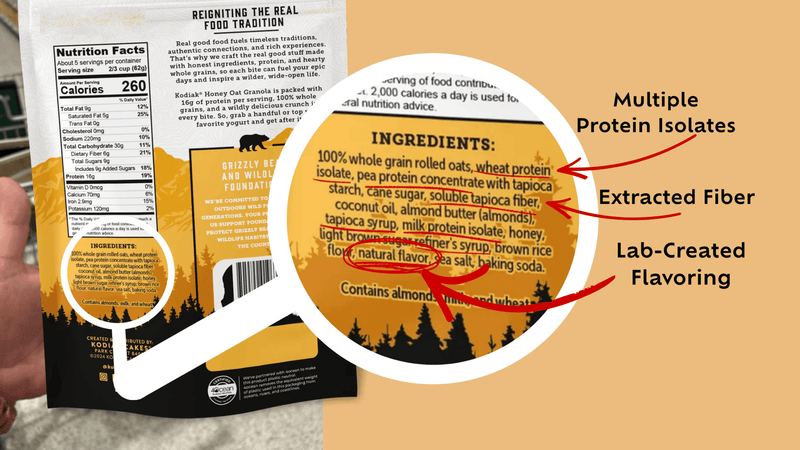
Part of what makes this so difficult for consumers is that the food industry has become very good at making ultra-processed products look healthy. Protein isolates get added to granolas, bars, and cereals so the nutrition panel shows an impressive number, but the isolate itself is a manufactured ingredient that your body does not process the same way it processes protein from almonds, walnuts, or oats. Synthetic sweeteners replace sugar so brands can print "zero sugar" on the front of the pack, while the ingredients doing the sweetening were created in a laboratory. Seed oils get dressed up as functional fats. The wellness marketing is loud but it is a false, unhealthy narrative. The ingredient list tells a quieter, different story. This is exactly the pattern we found when we compared four protein granola brands label by label. Read that breakdown here. And this is why the methodology behind a non-UPF certification matters so much. A program that only checks whether your fat, sugar, and sodium numbers land in the right range will pass a product loaded with manufactured ingredients without hesitation. It is measuring the outcome of processing, not the processing itself.
Some programs focus on nutrient thresholds, looking at sugar, fat, and sodium totals. Some screen the ingredients listed on a product label. Some evaluate how food is made. These approaches are often grouped together, but they differ significantly in what they actually measure. Some focus on nutrients or label screening, and while those represent meaningful progress, they do not fully capture the defining characteristic of ultra-processed food, which is how it is made. A product built from manufactured ingredients engineered to hit the right macro numbers passes a nutrient-threshold check without difficulty, but the food is still unhealthy. That is the gap.
California's proposed law, AB 2244, is modeled after the USDA Organic certification process in its administrative structure: accredited agents, departmental oversight, a formal application framework. That structure is promising. But AB 2244 would use the definition established in AB 1264, which is a hybrid of ingredient-type screening and nutrient thresholds. We do not yet know whether that definition will capture how food is made or only what its label lists and what its macros are. A state-backed seal will only be as rigorous as the standard it applies. The certification framework matters. The methodology behind it matters more, and it is hard to see a government agency being better at this than the private sector.
This is not skepticism about the California effort. It is an honest reason to understand what any verification program actually evaluates before you put stock in what it says. The label is not the answer. The methodology behind the label is what matters.
What WISEcode Measures, and Why The Distinction Is Real
WISEcode is a FoodTech AI company describing itself as the world's most comprehensive food information platform. The platform analyzes 15,000 attributes of over 854,000 packaged food products. Nutrition scientists and AI engineers built it together. Researchers at the National Cancer Institute, the USDA, and universities in the US and Canada rely on WISEcode's data to study links between food processing and health outcomes. WISEcode launched its Non-UPF Verified program at Natural Products Expo West in March 2026.
Unlike certification programs that rely on extensive paperwork and manual review, WISEcode's system uses a pre-built ingredient database and an automated review process. Most verifications complete instantly, and that was the case for all three Brekky Mix varieties.
Merricks Kitchen Co-Founders Sarah Tobin and Isabelle Tobin in the WISEcode booth at Expo West 2026
What separates WISEcode's approach is what it evaluates. Products receive one of five classifications, from Minimal to Super-Ultra Processed. The WISEcode UPF Standard examines individual ingredients, considers their degree of refinement, accounts for added sugar contribution, and flags industrial additives associated with heavy processing or potential health consequences. It does not ask whether your fat and sodium numbers land in the right range. It asks whether each ingredient in the product was chosen for what it contributes, and whether the food was built from real ingredients or manufactured to approximate them.
That is the question that matters. Real food is not defined by its nutrition panel. It is defined by whether every ingredient in it earned its place. WISEcode's evaluation asks exactly that. Most nutrition labeling does not.
Brekky Mix Earned Non-UPF Verification Without Changing A Single Ingredient
When Brekky Mix went through WISEcode verification, nothing changed. No ingredient was swapped. No formulation was adjusted. No label was rewritten. The product going in for verification was the same product we had been selling, because the ingredient decisions were already right.
Those decisions were never made with a certification in mind. They were made ingredient by ingredient, on the same basis WISEcode now uses to evaluate products: does this ingredient earn its place, and does it do something real for the person eating it?
We use extra virgin olive oil instead of seed oils, because extra virgin olive oil is minimally processed and retains its natural polyphenols, while seed oils require industrial refining, bleaching, and deodorizing. Brekky Mix contains organic Ceylon cinnamon instead of cassia, because Ceylon is sweeter, gentler, and does more for blood sugar management. We add organic Madagascar vanilla powder instead of extracts hiding behind the dubious food industry term "natural flavors," because vanilla powder delivers more bioactive compounds and carries no ambiguity about its makeup. Brekky Mix has organic ground flaxseed instead of whole seeds, because whole flaxseeds pass through the digestive system largely undigested, and the body properly absorbs the omega-3s, fiber, and lignans only when the seed is ground. We also use organic fair-trade, date-sweetened chocolate chips, because good chocolate does not require refined sugar. And we use pure, organic maple syrup, because it provides clean sweetness without competing flavors.
The way we select ingredients and the way WISEcode evaluates them are built on the same underlying principle. We ask the same question at the front end that WISEcode asks at the back end: what is this ingredient actually doing here?
Each of those choices cost more than the conventional alternative. Some cost significantly more. Madagascar vanilla powder runs $90 to $110 per pound. Ceylon cinnamon costs three to four times more than cassia. Ground flaxseed costs twice what whole seeds do. None of these were marketing decisions. They were ingredient decisions made because each one does something nutritious for the person eating it.
The Triple Zero standard at Merricks Kitchen, zero seed oils, zero refined sugar, zero artificial anything, was built as an internal filter long before any verification program existed. The standard was never set by what a label would say. It was set by what belongs in real food. WISEcode verification confirmed what our ingredient list already showed.
What Verification Cannot Create Retroactively
The conversation around non-UPF verification focuses almost entirely on what brands need to change. Which ingredients need to go. Which additives need replacing. Which processing methods need to be rebuilt from the ground up. That makes sense for most of the packaged food industry, because for most of the packaged food industry, the starting point was wrong.
But it describes a different problem than the one Merricks Kitchen faced.
Expensive Madagascar vanilla powder was in Brekky Mix before the Non-UPF Verified Shield existed. Ceylon cinnamon was in Brekky Mix before California legally defined ultra-processed food. Ground flaxseed, milled specifically because whole seeds pass through the body largely unabsorbed, was in Brekky Mix before Reuters classified UPF litigation as a mass tort to watch. Every one of those decisions carried a real cost with no certification to justify it, no shelf placement advantage to reward it, and no legal context that made it commercially necessary. We did it for our customers, and their health right from the beginning.
Our ingredient list was not built to pass a future standard. It was built because each ingredient earned its place by doing something functional for our customers.
Protein is a good example of how this plays out in practice. A lot of granola brands have added wheat protein isolate, pea protein concentrate, or milk protein isolate to boost the number on their nutrition panel. WISEcode evaluates each of those additions individually and flags them as processed ingredients. Brekky Mix gets its 8g of protein per half cup from almonds, walnuts, oats, and seeds. No extraction happened. No manufacturing step added them. They were already there because the ingredients that belong in real food were already there.
That distinction matters for one specific reason. Verification confirms a formulation decision. It does not create one, and it does not lower the cost of making the right one. The brands reformulating now to meet a non-UPF threshold are paying for a cost-optimized, often nutritionally ignorant starting point plus the cost of rebuilding toward something they should have started with in the first place. That is a different financial and ethical position than paying the cost of real ingredients at the front end and waiting for the rest of the industry to recognize what that means.
I read a lot of food research. What WISEcode's data shows for most products in its database is not surprising to me. Most packaged food was built to be cheap to make and hard to stop eating. The verification process just makes that visible.
For Brekky Mix, verification confirmed what we already knew about every ingredient in the bag. We were not waiting to find out if the formulation was right. We knew it was right. That is why nothing changed when the assessment came back.
The Sugar Story Shows Exactly Where the Rest of the Industry Is
The 500-calorie figure connects directly to the sugar story. NIH research found that people on a UPF diet consume approximately 500 more calories per day simply because the food is engineered to keep them eating past fullness. The precise calculation of sugar, salt, and fat that achieves this is what food scientists call the bliss point. It is not a side effect of how UPFs are made. It is the design intent. The reformulation challenge the industry now faces with sugar is a direct consequence of having built products around that intent for four decades.
The sugar context is worth a moment, because it illustrates the difference between building food correctly and spending years trying to fix food built wrong.
According to Innova's 2025 global Health and Nutrition Survey, two in five consumers are actively cutting back on added sugar, with 30 percent following a sugar-free or low-sugar diet. In response, food and beverage manufacturers across the industry are rebuilding sweetness from the ground up. They are turning to rare sugars, fermentation-derived compounds, precision glycoside blends, and complex multi-sweetener systems. Industry experts describe sugar not as a simple ingredient to swap out but as infrastructure: it provides bulk, mouthfeel, texture, browning, and shelf stability. It also makes consumers want more of their products despite them being bad for their health. Removing it without replacing those functions requires significant reformulation and often additional processing.
Brekky Mix naturally includes just 2 to 3 grams of added sugar per serving without any of those systems, and without any of the engineered mechanisms that push daily intake past what the body needs. No rare sugar blends. No fermentation-derived sweeteners. No reformulation. Food scientists and flavor experts now point to vanilla and cinnamon as flavor pairing strategies that amplify perceived sweetness, allowing manufacturers to use less sugar while maintaining taste. Ceylon cinnamon and Madagascar vanilla powder have been in every bag of Brekky Mix from the beginning, working together to create positive natural complexity so less maple syrup is needed, not more.
The food industry is now calling this "smart formulation." It is what you get when you start with real food and ask each ingredient to do its job, rather than starting with a cost-optimized base and trying to engineer your way back toward acceptable.
That pattern is worth watching closely, because it is playing out in real time. One of the world's largest ingredient suppliers recently built an AI tool specifically to help brands navigate this exact challenge, recommending new processed ingredients to replace the sugar they remove. We wrote about why that fix does not solve the problem it claims to in Less Sugar Should Not Mean More Processing.
What to Look For Until a State-Backed Standard Exists
Non-UPF certifications are multiplying quickly, and a state-backed standard is likely coming. What shape that standard takes, and how rigorously it measures processing versus just ingredients and nutrients, will determine how much it actually tells you.
Until that clarity exists, here is what separates a meaningful certification from a marketing label:
It evaluates ingredients individually, not just totals. A program that checks whether fat, sugar, and sodium land in the right range tells you nothing about how the food was made. Look for verification that examines each ingredient and its degree of refinement.
It flags industrial additives. Real food does not require emulsifiers, synthetic sweeteners, or protein isolates to function. A rigorous standard identifies those additions and accounts for them in the assessment.
It asks how the food was made, not just what the label lists. Ingredient screening is a step forward. Processing-level analysis is the standard that actually answers the question.
WISEcode applies all three of these criteria. Its platform evaluates each product ingredient by ingredient across five processing levels, with methodology behind the answer rather than marketing language in front of it. The Non-UPF Verified badge on Brekky Mix product pages reflects that assessment. So does every ingredient in the bag. Shop the full Non-UPF Verified lineup.
Common Questions About Non-UPF Verification
What is California Assembly Bill 2244?
Assembly Bill 2244, proposed in March 2026 by California Assemblymember Jesse Gabriel and the Environmental Working Group, would create a state-backed non-UPF seal modeled on the administrative structure of USDA Organic certification, including accredited agents and departmental oversight. If passed, large grocery chains in California would be required to display certified products in prominent, high-traffic areas of the store. The bill would use the definition of ultra-processed food already established by Assembly Bill 1264.
What is Assembly Bill 1264?
Assembly Bill 1264, signed by Governor Gavin Newsom, made California the first state in the country to legally define ultra-processed food. It also banned ultra-processed foods from school lunches. More than 30 states have since adopted similar food restrictions, following a pattern where California food legislation influences policy nationwide.
Why is ultra-processed food litigation being compared to tobacco lawsuits?
In January 2026, Reuters identified ultra-processed food litigation as a distinct mass tort category to watch, grouping it alongside asbestos, tobacco, and opioids. The legal pattern follows tobacco closely: individual consumer cases were historically difficult to win, but a public nuisance framework, which argues cities and counties bore the public health costs of treating related diseases, established the scale of economic damage as the central argument. San Francisco filed the nation's first government lawsuit against ultra-processed food manufacturers in December 2025 using this approach.
What does WISEcode measure that other Non-UPF certifications don't?
Many certification programs only check whether a product's fat, sugar, and sodium totals fall within a target range, which measures the outcome of processing rather than the processing itself. WISEcode evaluates each ingredient individually across five classifications, from Minimal to Super-Ultra Processed, considering degree of refinement and flagging industrial additives. It asks whether each ingredient was chosen for what it contributes, not just whether the final nutrient numbers look acceptable.
Did Brekky Mix change its formulation to get Non-UPF Verified?
No. When Brekky Mix went through WISEcode verification, no ingredient was swapped, no formulation was adjusted, and no label was rewritten. Ingredient decisions like using extra virgin olive oil instead of seed oils, Ceylon cinnamon instead of cassia, and organic Madagascar vanilla powder instead of natural flavors were made before the WISEcode shield, the industry lawsuits, or the new anti-UPF legislation existed.
What makes a non-UPF certification meaningful?
A meaningful certification evaluates ingredients individually rather than just checking nutrient totals, flags industrial additives like emulsifiers, synthetic sweeteners, and protein isolates, and asks how the food was made rather than only what the label lists. A program that only checks whether fat, sugar, and sodium land in an acceptable range will pass a product built from manufactured ingredients without flagging it.
Real food was always the answer. It did not need a verification program to make it true. But if a verification program helps more people understand it, then what that program actually measures is not a technical detail. It is the whole point.
“What's in your pantry is what you'll eat. Make sure it's the good stuff.”
The only pantry rule you need
BREKKY MIX PANTRY Staples
Try all three Brekky Mix varieties, save 10%, and have breakfast handled for weeks. Free shipping.
Brekky Mix has become a must have for my improved diet. It has a terrific, healthy blend of organic and nutritious ingredients and they really care out their customers with excellent service and responsiveness. Highly recommend!
Hi Kurt, thank you for your wonderful review! We're delighted to hear that Brekky Mix continues to be an important part of your morning routine.
Excellent! Appreciate all the wholesome ingredients with tons of amazing flavor.
Thank you for your wonderful feedback! We're delighted to hear you enjoyed our clean ingredients and flavor - they're why we created Brekky Mix in the beginning! We very much appreciate your support!