When I think back to how I grew up in Australia, I like to tell people my brother and I were basically in a refined sugar witness protection program! We only got to eat candy at friends' parties, and we never had soda, or anything like a pop tart or oreo. While other kids were trading Warheads at recess, I was the one with a lunchbox full of things that actually came from the ground. Did I resent it? Absolutely. Did I spend a suspicious amount of time hiding wrappers in my brother's room and stuffing contraband into my jean pockets? Also yes.
The reason for all of this? My own mother. She read every food label like it was a legal document she was about to sign, and products laden with sugar didn't stand a chance of making it through our front door. I didn't think of the way we ate as a lifestyle or a philosophy - it was just food. Seasonal fruit in a big wooden bowl on the counter. Nuts, seeds, whole grains, and olive oil in the pantry, and dinner cooked from scratch most nights. I didn't know there was a name for it until much later in my life. It was just the thing that we did.
Here's the thing, though - my mum was right about all of it. And it took moving to California to really understand just how right she was.
When I Landed in America, I Refused to Eat Breakfast
I was 13 when we moved to California, and I want to be upfront with you: the American breakfast situation was not something I was prepared for.
When I landed in America, I didn't just experience culture shock. I experienced a full-on food crisis. The stuff lining the shelves looked familiar enough, but one glance at the ingredients, and I felt like I needed a chemistry degree to understand what I was eating. Back home, food tasted like food. Here, I was expected to be okay with 47 ingredients and 500g of sugar in a granola bar…maybe an exaggeration, but I was not okay with it.
Pancakes drowning in syrup. Cereal that tasted like dessert. Bread was so sweet I could taste the sugar before it even hit my tongue. I turned down the toast. I turned down cereal. I refused the bun at In-N-Out — which, if you know anything about In-N-Out, is a tragic way to experience In-N-Out. (I did eventually come around. The bun won. Some battles are worth losing, and that was absolutely one of them.)
California felt health-conscious on the surface - fresh produce, farmers markets, avocado on everything - but it was still nothing like what I was used to. So we did what felt natural: we cooked everything ourselves. Every night, every morning, almost every meal. I didn't really notice how much we avoided packaged food until years later, when I had to start doing the grocery shopping myself and stood in the cereal aisle, genuinely overwhelmed by how many things were pretending to be healthy while quietly being the opposite.
Starbucks and the 13.5 Teaspoon Wake-Up Call
Here's the thing about growing up in Australia: breakfast is an experience. You sit down. You talk to whoever's there. A proper flat white arrives in a ceramic cup, made by someone who genuinely cares. Breakfast is a ritual, not a transaction.
Starbucks was a rude awakening in every sense of the phrase.
The real lesson came when I was about 15. I'd ordered a Grande Caramel Frappuccino - a completely normal teenage thing to do, I thought. FBI Agent Sarah (AKA my Mum) asked me to look it up on my phone. 54 grams of sugar. In one drink. We did the math: 54 divided by 4. That's 13 and a half teaspoons. I went home and actually counted them out into a bowl just to see what that looked like in real life.
It was a lot. An almost comedic amount. And I'd been drinking it on the way to school like it was nothing.
Mum didn't shame me or lecture me. She just showed me the numbers, handed me the tools to understand what they meant, and trusted me to make better choices with that information. That approach stuck with me far more than any rule ever could have. I actually enjoy reading labels now. I notice when something has 11 grams of added sugar and three types of "natural flavors." I reach for the package with ingredients I can picture over the one with ingredients I can't pronounce. It's just how I see food.
The Food Snob With a Busy Schedule and Nowhere to Turn
I was a competitive athlete throughout high school and college, which meant food wasn't just about enjoyment; it was about fuel. I needed consistent energy, real nutrition, and food that didn't make me feel terrible an hour after eating it. And I was busy. Training, studying, traveling for competition. Convenience wasn't optional.
The problem was that almost everything convenient was something I didn't want to eat. I'd stand in the granola aisle reading labels and putting things back. I'd pick up protein bars and squint at ingredient lists that read more like a chemistry exam than a food product. I love food, and I'll happily eat my way through a new city, try anything at a great restaurant, and get genuinely excited about a farmers market find. But packaged food has always been where I struggled. I knew what real food tasted like. Most of what was on those shelves just didn't qualify.
I didn't really have a solution. I just kept cooking everything myself and quietly resented the granola aisle.
Until we made our own.
What's Actually Wrong With "Healthy" Granola
Before I tell you about Brekky Mix, I need to talk about the granola aisle for a moment, because it is one of the more quietly deceptive places in any grocery store.
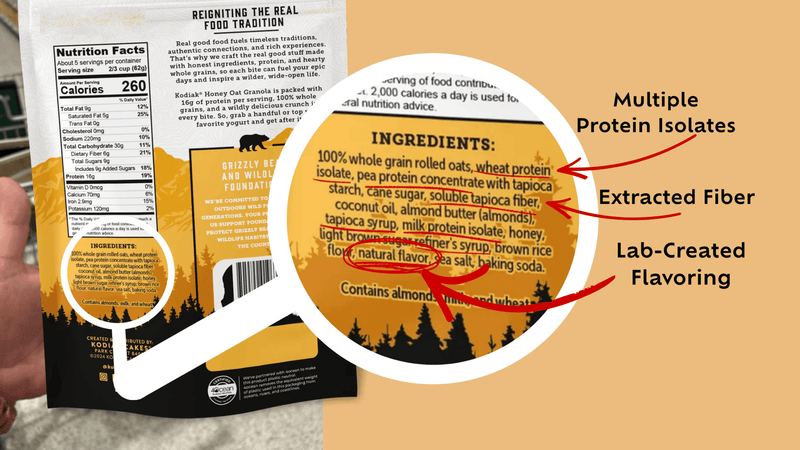
The packaging says "wholesome" and "natural" and "clean." The nutrition label tells a very different story. Most mainstream granolas carry 7 to 12 grams of added sugar per serving - some go higher. They're made with seed oils or coconut oil. They list "natural flavors" as an ingredient, a catch-all term that can mean almost anything and usually indicates the real ingredients aren't doing enough on their own. The serving sizes are sometimes listed as a quarter cup or even tablespoons, purely to make the sugar numbers look better on the label. It's not an accident. It's a choice. We break down exactly how to spot this on any label in our guide to what actually makes granola healthy.
Here's something that genuinely surprised me when Mum and I started researching this: the Mediterranean diet is one of the most studied and recommended eating patterns in the world. Olive oil, whole grains, nuts, seeds, minimal processing, real ingredients. The evidence behind it for heart health, brain health, and longevity is extraordinary. And yet almost every conversation about Mediterranean eating focuses on lunch and dinner. Breakfast is a complete blind spot.
Go look at the granola aisle and count how many products use extra virgin olive oil. Almost none. The market has been applying totally different and frankly lower standards to the first meal of the day for decades, and most people don't even realize it because the packaging is so convincing. We go deeper into why olive oil belongs in your granola bowl in our piece on olive oil granola and the Mediterranean diet.
This matters more than it might seem, because breakfast sets the tone for your entire day. A high-sugar breakfast creates a spike and then a crash. You're tired, irritable, and reaching for snacks before lunch. A breakfast built on protein, fiber, and healthy fats does the opposite. It holds you steady for hours, keeps hunger at bay, and quietly supports everything from your gut to your skin to your energy levels. Every part of the body functions better when it's supported as a whole rather than in isolation. The right breakfast isn't just about the morning. It affects everything that comes after it.
The recently released Dietary Guidelines for Americans now explicitly recommend reducing packaged breakfast options as part of a broader push away from ultra-processed foods. When the U.S. government, which rarely admits anything, starts saying something is a problem, that should tell you something.
So We Built What Didn't Exist
So we did what any reasonable person with a serious problem would do - we found our own solution by making our own. That's how Brekky Mix was born, and eventually, Merricks Kitchen.

We took every principle Mum had been teaching me since I was old enough to flip over a cereal box and applied it to a product we actually wanted to eat every morning. Extra virgin olive oil instead of seed oils - not as a trend, but because it brings genuine nutritional value, heart-healthy fats, and polyphenols with real anti-inflammatory properties. Pure maple syrup is the sweetener, used sparingly enough that added sugar sits at just 2 to 3 grams per serving. Twelve to fifteen whole food ingredients with names you can actually read: organic gluten-free oats, almonds, walnuts, pumpkin seeds, sunflower seeds, ground flaxseed, organic coconut flakes, Ceylon cinnamon, psyllium husk, and Madagascar vanilla powder. Zero sodium. No ultra-processed shortcuts. No "natural flavors" standing in for something you'd rather not know about.
Real stuff. The kind my mum would actually approve of - which, trust me, is not a low bar.
What we were really trying to build wasn't just a better granola. It was a better breakfast ritual. In Australia, breakfast was never something you rushed through or grabbed off a shelf without thinking. It was a moment - you sat down, you were present, you ate something that actually tasted as if it came from somewhere real, not a science lab. We wanted to bring that to a market that had, for some reason, decided that breakfast didn't deserve the same high standards as other meals. We think it does. We think you do too. If you're deciding between granola and muesli specifically, our granola vs muesli breakdown walks through exactly where Brekky Mix landed between the two.
How to Build a Breakfast Worth Waking Up For
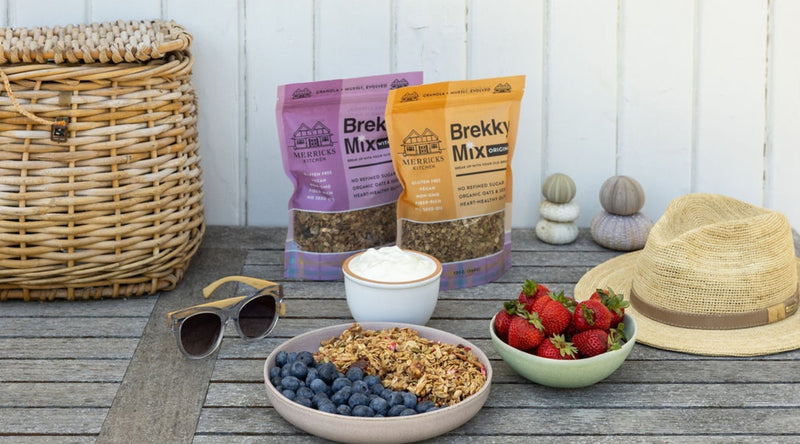
The formula is simple because it doesn't need to be complicated: Brekky Mix + probiotic dairy + seasonal fruit. That's it.
The Brekky Mix handles the foundation - protein from nuts and seeds, fiber from oats, flaxseed, and psyllium husk, healthy fats from extra virgin olive oil, and whole nuts. Greek yogurt or kefir adds creaminess and gut-supporting probiotics. Fresh fruit brings brightness, natural sweetness, and whatever the season is currently doing its best work with. Layer them in a bowl, and you have something that takes two minutes to make and somehow tastes like it took twenty.
The Spring Awakening Bowl: half a cup of Brekky Mix Original, thick Greek yogurt or Skyr, fresh strawberries, and sliced kiwi. The Ceylon cinnamon warmth against cold, bright fruit is one of those combinations that just works every single time.
The Golden Hour Bowl: Half a cup of Brekky Mix With Fruit, coconut yogurt, fresh mango, and a squeeze of lime. The dried fruit in the mix meets fresh mango, and it tastes like somewhere warm and far away. Perfect for eating outside on a spring morning.
The Garden Party Bowl: Half a cup of Brekky Mix Original, Greek yogurt, fresh raspberries, and a small handful of mint. The mint sounds unexpected. It makes the whole bowl taste like a meal at a beautiful café near the water. Currently, my favorite, and I've made it four days in a row without getting tired of it.
The Evening Dessert Bowl — A third of a cup of Brekky Mix Choc Chip over low-fat unsweetened kefir mixed with chia, cacao, and a little honey. Make the kefir base in a jar about 20 minutes before you’re ready to eat it, and it becomes something close to a rich chocolate mousse. Add sliced banana and fresh cherries. Eat it at 7pm. Feel absolutely zero guilt, because the chocolate chips are date-sweetened and fair-trade, and ⅓ of a cup of Brekky Mix Choc Chip clocks in at 2 grams of added sugar. I eat this after long days and consider it a completely legitimate reward.

The consistency of eating like this - really eating like this, not the packaged imitation of it - is what actually shifts things. People tell us they notice it in their energy, their skin, their digestion, and the way they feel by mid-morning. That's not a coincidence. That's what happens when breakfast stops being an afterthought. Want more no-cook ways to work Brekky Mix into your week, especially once the weather warms up? Our quick and easy summer ideas cover frozen bark, smoothie bowls, and more.
The Bigger Picture
The average American consumes 71 grams of added sugar every day. The American Heart Association recommends 25. That gap - nearly three times the recommended amount - doesn't happen because people are making obviously bad choices. It happens because sugar is hidden in foods that seem perfectly reasonable. Granola. Yogurt. Drinks. Bars with wellness branding and ingredient lists that require a chemistry degree.
Once you know how to read a label, you can't unknow it. And once you taste breakfast made from real food, you stop being able to settle for the alternative.
That's the whole idea behind Merricks Kitchen. Not to make healthy food feel like a sacrifice, but to make real food feel like the obvious choice — because when it tastes this good and makes you feel this good, it genuinely is. The standard we built Brekky Mix to is the standard we think all packaged food should be held to. We're not asking for anything radical. Just ingredients you recognize, fats that are actually good for you, and sugar levels that don't require a calculator to process.
Mum figured that out a long time ago, standing in grocery store aisles flipping over boxes. I just finally caught up.
There's a lot that happened in between, and I think you'll find it equal parts interesting and ridiculous. I'll show you what actually matters on a food label, what's quietly lying to you, and how to live a genuinely indulgent life without the guilt - because the food is that good.
Welcome to Merricks Kitchen. Pull up a chair.
 
|
Isabelle grew up in Sydney, Australia, before moving to California at 13. She spent years refusing American breakfast, eventually made peace with the In-N-Out bun, and co-founded Merricks Kitchen with her mum, Sarah. She still reads every label. Old habits. |
Brekky Mix is handcrafted in small batches in Orange County, California. Granola + Muesli, Evolved.